Posts

Vedic Literature

Image
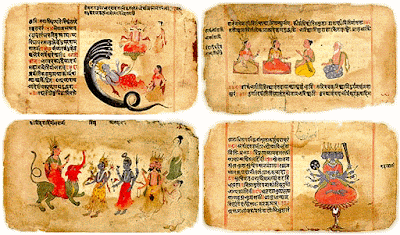
    The word ‘Veda’ is derived from the root ‘vid’, which means to know. In other words, the term ‘Veda’ signifies ‘superior knowledge’. The Vedic literature consists of the four Vedas – Rig, Yajur, Sama and Atharva.      The Rig Veda is the earliest of the four Vedas and it consists of 1028 hymns. The hymns were sung in praise of various gods. The Yajur Veda consists of various details of rules to be observed at the time of sacrifice. The Sama Veda is set to tune for the purpose of chanting during sacrifice. It is called the book of chants and the origins of Indian music are traced in it. The Atharva Veda contains details of rituals.  (Ramayana and Mahabharata)      Besides the Vedas, there are other sacred works like the Brahmanas, the Upanishads, the Aranyakas and the epics Ramayana and Mahabharata. The Brahmanas are the treatises relating to prayer and sacrificial ceremony. (Brihadaranyaka Upanishad) The Upanishads are philosoph...

ORIGIN AND IDENTITY OF ARYANS (VEDIC CULTURE)

Image
Aryans spoke the Indo-European language, Sanskrit. They seem to have lived somewhere in the area east of the Alp, in the region known as Eurasia. But the  original home of the Aryans is  still  a debatable question and there are several views. Different scholars have identified different regions as the original home of the Aryans. The earliest life of Aryans seem to have been mainly pastoral. They used several animals. The most important was Horse. But it should be remembered that this animal was unknown to the Harrapans. And some historians remarked that because of horse, Aryan could come to India.  

VEDIC CULTURE

Image
Introduction The cities of the Harappan  Culture had declined by 1500 B.C . Around this period, according to Rig Veda, Aryan (Earliest specimen of the Indo-European languages, Sanskrit) entered the north-west India from the Indo-Iranian region.  First, Aryan appeared in Iran, where Indo-Iranians lived for a long time. And then they came to India. Their initial settlements were in the valleys of the north-west and the plains of the Punjab. Later, they moved into Indo-Gangetic plains. As they were mainly a cattle keeping people, they were mainly in search of pastures. By 6 th century B.C., they occupied the whole of North India, which was referred to as Aryavarta. This period between 1500 B.C and 600 B.C may be divided into the Early Vedic Period or Rig Vedic Period (1500 B.C -1000 B.C) and the Later Vedic Period (1000B.C-600 B.C). Origin and Identity of Aryans Aryans spoke the Indo-European language, Sanskrit. They seem to have lived somewhere in the area east of the Alp, in th...

Vedic Education - Aims, Salient features, Special reference to Curriculum and Method of teaching.

Image
Introduction In ancient Indian education emerged from the Vedas because the Vedas are the sources of Indian philosophy of life. The Veda means knowledge. In that period the education was divided into two kinds of knowledge, one is ' This Worldly'  and another is ' Other Worldly ' . (Worldly and Other Worldly) 'This Worldly' dealt with the social aspect  whether the 'Other Worldly' related to intellectual pursuits for achieving salvation. However the greater Emphasis was laid on the letter, because education was considered as the mean of free from life bondages. SYSTEM OF EDUCATION DURING VEDIC PERIOD The system of education during the vedic period was totally different from Today's education system. The student life in vedic period was began with Upanayana ceremony.  This was performed for 3 days. And the students go to this chosen teacher, called as Acharya.  (Upanayana or Thread Ceremony) The place of learning w...